

















People don’t talk much anymore. This may seem like hyperbole, but looking around in the library during a free period proves it. Students sink deeper and deeper into their devices, hiding from social interaction and more meaningful conversations. While social media can be used to connect with friends, it can often become addictive, leading to a constant need to check for new notifications. To this extent, I argue that a completely phone-free student body would better our community.
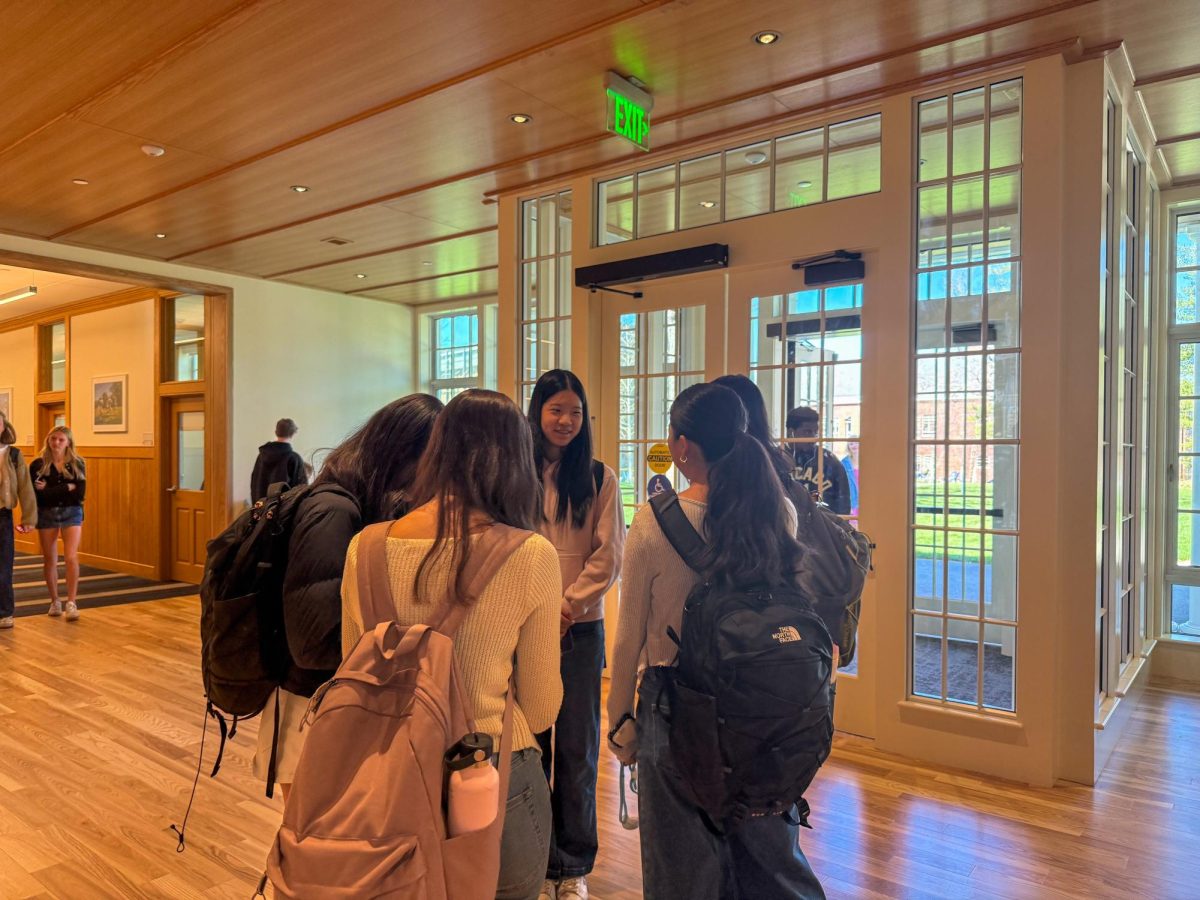
While most of the student body depends on constant phone use during free time, middle school students go entirely off the grid each day. They stash their phones in the affectionately (and maybe not-so affectionately) named “phone jail” before assembly and then pick them up at the end of their academic day. One has to be careful when walking by the phone jail at this time, as middle schoolers dangerously stampede to receive their phones. Yet, talking with two middle schoolers in person (which naturally only happened because we were not on our phones) showed an overall contentment with the policy. “I think it’s nice to talk to someone face to face,” Sino Masiiwa (Class V) said.
It is refreshing to speak to someone directly, and it often takes not having a device nearby to initiate a conversation like this. Our generation’s addiction to technology is not our fault: programmers want people to continue interacting online and are constantly finding ways to keep us more engaged with their devices. “What’s hard is that for everyone, technology is very tempting, and when you hear a buzz, it’s almost impossible, no matter your age, not to react, even if it’s just telling you that your next class is starting,” Middle School History Faculty Melissa Lyons (N ’97) said. Therefore, the responsibility to push back against the vortex of technology falls onto Nobles students.
Over the past few years, the administration has implemented specific restrictions, prohibiting phone use in the Castle, bathrooms, Lawrence Auditorium, and classrooms. “I think it’s easier as adults if we can make a rule that everyone has to follow so that kids don’t have to self police,” Lyons said. In principle, these external rules combat the all-consuming nature of phones and benefit students. Unfortunately, poor enforcement of these rules has rendered them ineffective, with many students mentioning they don’t follow them very closely because there isn’t much consequence.
Many upper schoolers believe that a phone-free school day is feasible. “I just don’t think there’d just be as much of a difference as most people would think,” Devin Reid (Class III) said. Reid argues that students would feel less disturbed by being without their phones than they might initially expect, given that phones are already prohibited in the locations where they spend most of their time.
Conversely, in places where phones are easily accessible, students will automatically scroll because of a constant need for something to do. But this reflex is not necessarily the most rewarding or enjoyable. “I would much rather waste time being with other people than on my phone,” Camilla Mangal (Class II) said. While the idea of being off the grid for the school day seems daunting, in practice, students wouldn’t notice or be affected by it as much as they worry.
Across the nation, attempts at phone-less campuses have generally succeeded, showing signs of improved grades and behavior after a brief period of discontentment. In fact, according to a study conducted by ABC News, student test scores significantly improved in the second year of a phone ban (about 2-3 percentiles higher than the year before the ban).
Logistically, most students can organize their days effectively on their computers or paper. The middle school teaches students year after year how to survive without their phones and use physical planners. It doesn’t seem worth it to undo these skills when students enter the upper school. Knowing how to organize tasks and follow a schedule in print is a helpful skill that students will have to use throughout their lives.
Without phones, students could participate in other activities that are often much more rewarding and fun than burying their faces in technology. By working on a puzzle, playing Spoons, and even hacky sack outside, Nobles students are already effectively integrating phone-less habits into their school life, whether they know it or not.