




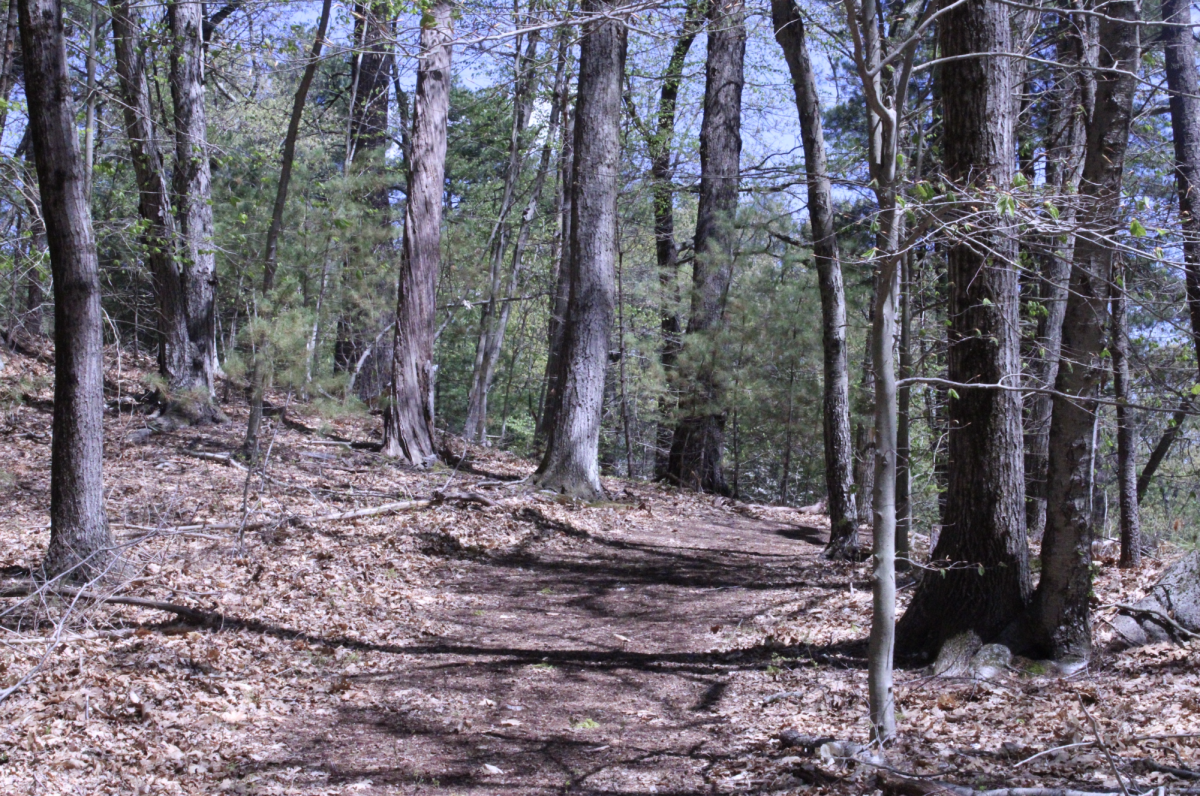











The Nobles Cross Country teams have long used Kern’s Course to train and compete, contributing to their success over the years. Looking ahead to a forthcoming renovation of the Omni, however, the current cross-country course may be interrupted. This led Boys Cross Country coaches Stephen Wallis, Dave Ulrich, George Blake, and Robert Kern himself to work towards clearing out a new trail to expand Kern’s Course along the turf. Blake said, “There has always been interest in maybe seeing some more possibilities for trails in different parts of the course on campus. So over the last few years, I think there’s just been conversations of ‘I wonder where we can make trails.’ I think there’s always been that curiosity.”
As of now, the new course is intended only for practice, and it is still to be determined whether it will be used in races. “Right now, it’s in its nascent phases,” Ulrich said. “We don’t know whether it’ll be part of the official course, but what it is great for is opening up a really beautiful area of our campus for people to train and to walk and get a sense of the natural environment.”
The environmental and natural aspects of the new course pay notable dividends not only for runners, but also for families on campus and other pedestrians who enjoy walking around our campus. “Our course allows you to see a variety of different examples of the nature that we have available, the resources we have around campus, and nature itself,” Wallis said. “So this new trail was an opportunity to expose people to a different part of campus that we didn’t have previous access to.”
The new trail is expected to provide better footing than other parts of the course. Blake said, “A lot of our course has some treacherous footing with roots and rocks, and where we’ve made these new trails, there are some technically difficult spots, but for the most part, they’re much better footing and better ground.”
The addition to the XC course not only provides more space for the team but also helps runners avoid more cars on campus. Ulrich said, “In terms of safety, one of the great things about this is that it helps to avoid traffic, and that’s become more and more of an issue on campus.”
In deciding where the trail would be, coaches prioritized having a minimal environmental impact, avoiding having to do things such as cutting down trees. “We tried to make the path one where no live trees needed to be cut,” Wallis said.
Not only does the course serve practical purposes for runners and people taking walks on it, but also for future classes that deal with the environment, such as AP Environmental Science, and the new upcoming senior elective course, “Campus Ecology and History of Place,” taught by Ulrich and Science Faculty Deb Harrison. Ulrich said, “I am looking forward to teaching a senior capstone course with Harrison about our campus and [architect Frederick Law] Olmsted, and to be able to highlight the sort of natural landscape of our own campus.”
Getting to observe how others in the community utilize the course has proven its practicality and durability. Wallis said, “I’ve enjoyed watching the kids enjoy it. They get to go back there and explore a new portion of campus and new trails. So the kids’ excitement about having new places to run has been nice to see.”