














Pro (Alexa)
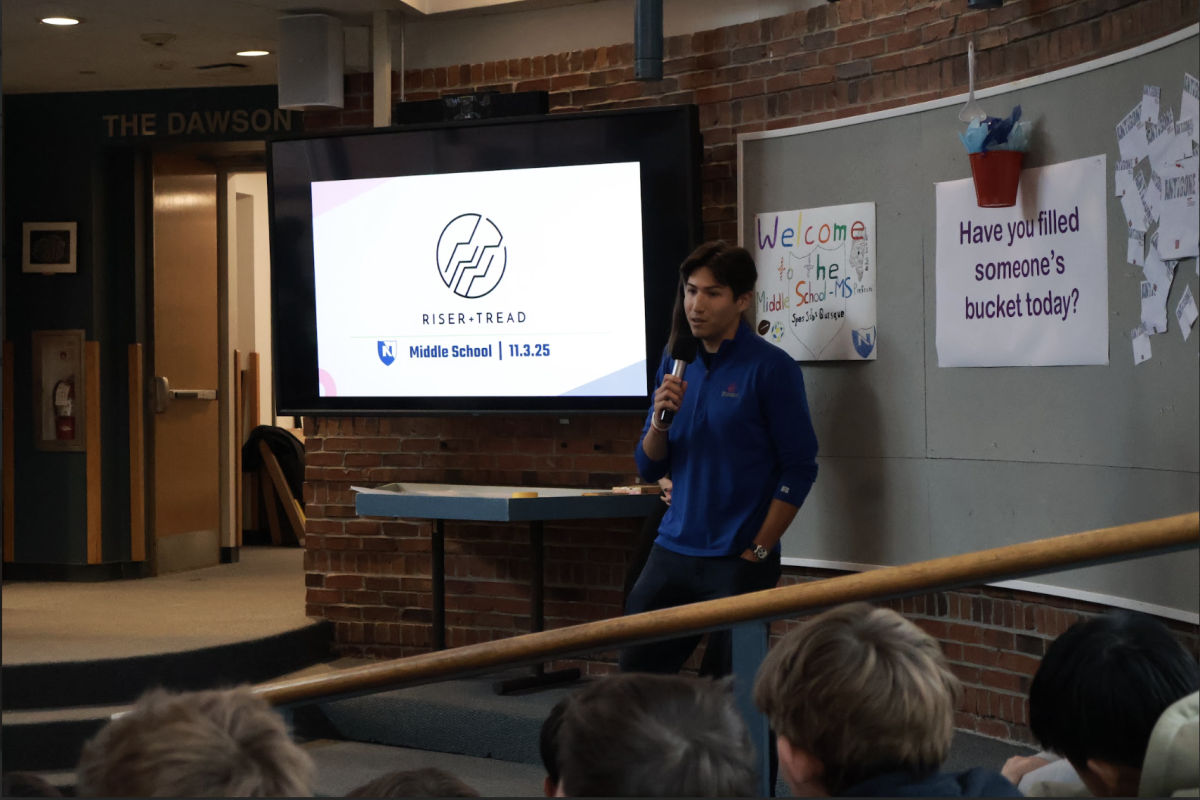
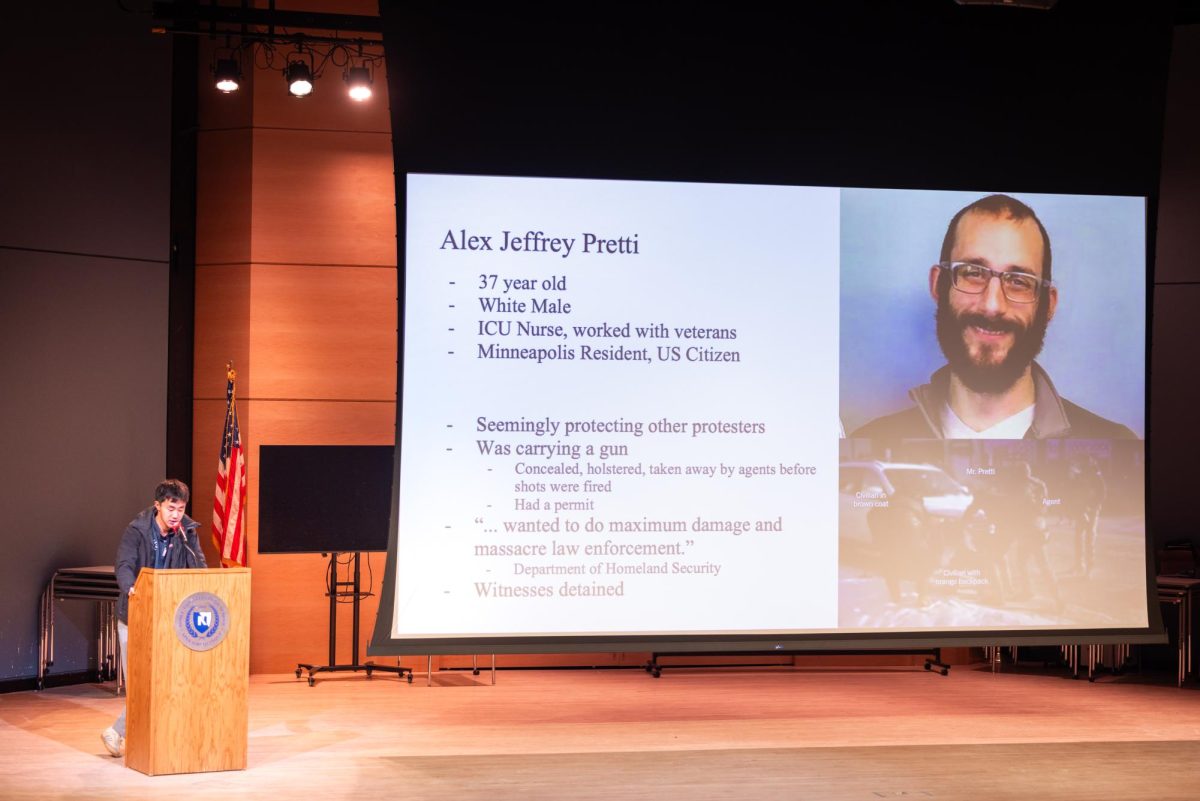
Following assembly on Monday, February 2, 2026, Science Faculty Sheila McElwee began three of her four AP Chemistry sections in the same way. “Everyone share one thing you learned from the prefects’ presentation,” she said. McElwee was referring to the five senior prefects who spoke in Lawrence Auditorium with their presentation entitled “ICE: Its History, Controversies, and Impact.”
In response to her prompt, many students expressed appreciation for the prefects’ presentation. McElwee said, “Students enjoyed sharing what they had learned and how it had changed their perspective. Many students did not realize how active ICE has been locally.”
McElwee’s decision to raise the presentation in her classes demonstrates why current events should continue to be mentioned in assembly: to spark further conversations about them in the community.
As Lia Gavin (Class I), one of the prefects who presented on February 2, described, the decision to stand on the Lawrence stage involved much preparation. “In one of our prefect meetings a month or so ago, when there were just a lot of things happening in the country that we [had] heard a bunch of students [were] concerned about … we brought [them] up to [Head of School Cathy] Hall and talked a while about what we [could] do as a school,” she said. This meeting resulted in the compilation of a slideshow that was reviewed by Hall, Head of the Upper School Alison Easterling, and Director of Assembly Programming Michael Polebaum.
Assembly naturally appealed to the prefects because it is an effective way to quickly spread information to the broader community. McElwee said, “The main ‘pro’ [of presenting in assembly] is that it creates a pool of common knowledge for discussion and exploration; it initiates conversation, stimulates curiosity, and may even spur people to action.” By using a portion of the community’s unique time together in the mornings, students and faculty can learn about topics they might not otherwise have time to explore.
At the same time, a growing concern is that information onstage omits or includes only certain details that exhibit the presenter’s biases. However, because sources of information naturally reflect one’s beliefs, choosing whether something is a “fact” can always be debated, and it is simply impossible to avoid implicit bias. Still, assembly can be used as a platform to introduce current events, and rather than taking every presentation at face value, community members should strive to question and stay curious about what is presented to them. Alex Mitchell (Class II) said, “No one’s asking for anyone to go up in assembly and provide a solution or tell you what to believe.” Presentations, like teachers, do not aim to tell the community what to think, but encourage new levels of thinking.
While some may be frustrated by the lack of spotlight on topics they care about, the assembly stage is just waiting to be filled with such presentations, particularly those that don’t simply hammer home the same political beliefs. Gavin said, “We should really work on making sure that our community is a place where people feel that they can share their voice and share their opinions.” Hall continues to encourage anyone, not just prefects, to raise their viewpoints in assembly. She said, “If it matters to our students and they want to bring it forward, I think that’s something that should be up on stage … And so [if] people say, ‘Why didn’t we talk about [so and so]?’ I’d say, ‘Well, why didn’t you get up on stage and bring that up?’” Despite the impression that certain similar viewpoints have been propagated in the past and can only continue to take up space in assembly, Lawrence remains open to all types of community expression.
Just as it is nearly impossible to remove all implicit bias from a presentation, it is also impossible to ensure that everyone in the audience will resonate positively with its message. Rather than not presenting at all, an alternative is to assume greater responsibility for one’s words and actions when discussing current events intertwined with identity and safety. Hall said, “When someone says something on stage that is not well-planned or thought through that causes harm, even if unintentional, it can have a lasting impact on the community.” By careful preparation, harm can be mitigated. As is the goal of most of Nobles’ curricular classes, individuals should be able to stick by their claims with evidence. Simultaneously, it is understandable that mistakes will occur or unexpectedly hurtful words will be said on stage. The possibility of such situations should not deter the community from addressing current events, as it is vital to learn from unpleasant experiences.
Assembly is a sacred space, but that doesn’t mean it has to be comfortable all the time. McElwee said, “The tradition … [of assembly being] a time to build and uplift the community … must be balanced with the growing pulse for assembly also to be a place to better understand the larger community.” This situation is not all-or-nothing. Current events can be presented in assembly and discussed afterwards. The purpose of assembly is not solely to introduce topics, but to invite further conversation within the community.
Con (Grace)
Although Nobles students should be educated on current events throughout the nation and world, all-school assembly is not an appropriate forum to discuss them. One of the greatest benefits of assembly is that anyone, from Sixies to seniors to faculty members, can get up on stage and perform or share something that is important to them. However, that poses a significant problem when it comes to the discussion of current events: Presenters are not required to have extensive knowledge of the subject they wish to speak about. Christian Weller (Class II) said, “I think when people are presenting, they can choose the facts and data they want to include to write the story they want to tell. I feel like students see a lot of stuff on TikTok or from one or two sources and immediately shape their views.” Students have no way of knowing who is qualified to speak on a subject or whether they are including all the information necessary to develop an unbiased opinion.
Head of School Cathy Hall said, “Implicit bias is always present in what we choose to say, which is inherently true for all of us. While we can and should work hard to reduce bias, it is important to be attuned to the biases we each have in what we choose to say and do and how that might impact others.” No matter the topic, the presenter can pick and choose which information to include or omit. This bias creeps into the facts that are presented and even the language presenters use. Not only that, but the presenter, whether consciously or not, has the ability to misrepresent opposing opinions. Although it is important to be able to listen to others’ perspectives respectfully, it can be frustrating for students who don’t feel that their opinions are being fairly represented.
Assembly does not offer a space for fluid discussion. The community hears moving speeches from various presenters but is given no time to process what they learn. Alexander Meng (Class II) said, “I feel like at 8 a.m., a lot of information goes in one ear and out the other, so it’s probably not the best place to be talking about these things.” An alternative to presentations on current events in assembly would be to have these conversations in small groups, either in the classroom or in affinity groups. Rather than a one-directional speech, these more intimate settings offer a space for dynamic and respectful debate and disagreement. Hall said, “Smaller groups are always a better place to foster healthy discourse, as assembly is not intended to be a place for conversation. I think there is great value to at times being in discussion within an affinity space with shared identities and at other times in spaces with a wide range of identities in the room. Both hold great value for fostering healthy discourse.”
Despite this, the greatest danger of discussing current events in assembly is the safety and well-being of younger students. There are incredibly graphic and horrifying videos available on the internet of the assassinations of Renée Nicole Macklin Good, Alex Pretti, and Charlie Kirk. Meng said, “When you hear about things in assembly like these shootings, that can lead you to look it up on TikTok, and obviously, there are videos of it that are really scarring and sensitive.” If students, especially middle schoolers, hear about something in assembly that leads them to investigate further, they risk discovering images they aren’t emotionally mature enough to handle. “There are topics I don’t think are healthy for a middle schooler to be wrestling with in assembly. There are issues that you need to have emotional and intellectual maturity to deal with. That’s something that can be really tricky as a 7th through 12th grade community as we think about how best to address very complex issues as a school,” Hall said. Sixies should be making new friends and playing kickball at recess, not spending their time dwelling on the future of our country. This showcases that another benefit of classroom discussions rather than assembly presentations is that teachers can communicate an age-appropriate version of an event to a 12-year-old rather than an 18-year-old.
The way current events are presented and the events the community chooses to discuss on stage broadcast the topics Nobles cares about most. With so much turmoil in the world, each student has something different that they feel strongly about that is unique to their identity. However, the school cannot address all of these problems, and the choice of what events to talk about can send a message that one student’s worry is more important than another’s. Hall said, “I worry we could fill an entire week with pretty heavy topics. At times, assembly is for those moments, but it’s also for joy, fun announcements, NED talks, performances, and more. If we move towards assembly always being used for a heavy reckoning of what’s happening in the world, that would really shift the tone of this important community space.” Lawrence is designed to be an uplifting place to start our school days, and if we let it solely become a space for devastating stories and polarizing conversations, it would be hard to recover.
Discussing current events in assembly has the potential to do more harm than good. It should be the responsibility of students to educate themselves on these events by participating in small-group discussions as well as their own research, and assembly should remain a safe, comfortable, and joyful space for everyone in the community.