













“America is called the melting pot. It’s a place where people are supposed to come and be able to start a new life. It seems like we’re trying to keep everyone out, and I feel like that’s not what America is,” Zach Roumain (Class II) said. President Trump’s executive order targeting birthright citizenship has forced students to evaluate the limits of presidential power, the nature of the Constitution, and the values that define America’s identity.
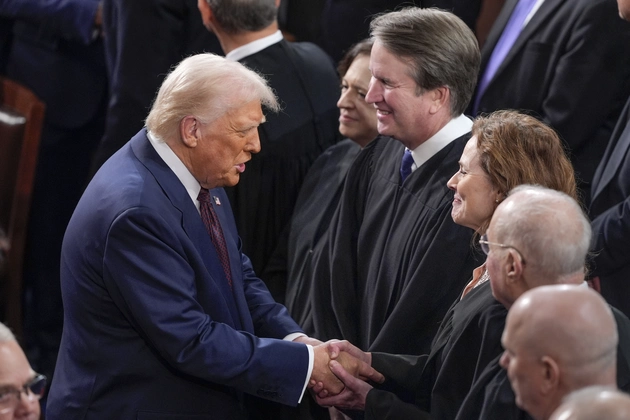
During his second term, President Trump has wielded executive orders — presidential directives that carry the same force as a law but do not require Congressional approval — at an unprecedented pace in recent history. As of April 2026, he has signed 254 executive orders that cover a wide range of topics, from immigration and trade to elections and federal agencies. Birthright citizenship, the guarantee that anyone born on U.S. soil is automatically a citizen, was enshrined in the 14th Amendment and affirmed by a Supreme Court ruling in 1898. Trump’s birthright citizenship order would remove automatic citizenship status from children born in the U.S. to undocumented parents or parents on temporary visas. While Trump signed this order in January of 2025, federal courts blocked it before it could take effect. The Supreme Court heard arguments for this case at the beginning of April 2026, and if allowed to stand, this order would strip approximately 9% of the 3.6 million babies born each year in the U.S. of their citizenship. At the center of the contention is the 14th Amendment’s phrase “All persons born or naturalized in the United States, subject to the jurisdiction thereof, are citizens of the United States and of the State wherein they reside,” which the Trump administration argues excludes children of non-citizens.
Students seem to agree with one another that executive orders should play a narrow role in American government. “Executive orders should only be used when there is an urgent and immediate threat to the United States,” Ayaan Mohammed (Class II) said. Alex Yoon (Class I) further elaborated on this belief. “Executive orders should be used when the time required to get proper congressional approval simply isn’t sufficient,” he said. For many students, using executive orders outside of these specific circumstances undermines the democratic process and the purpose of legislation. “Sometimes when executive orders are used, especially recently with Trump, they’ve been used to skirt the separation of powers. Using executive orders just to get around congressional approval is not constitutional,” Raul Cruz (Class II) said.
Students also considered whether the 14th Amendment, and historical documents more generally, should be interpreted through historically established settled law or through continuous conversation over literal wording. Yoon said, “Following the spirit of the law is better than following the literal law itself. Times change in America, and the U.S. in the current day is not the same as the U.S. back in the 1800s.” Roumain agreed with this sentiment and further explained the risks of a strong focus on exact wording. “If you want to get nitpicky with all the specific wording, there are so many loopholes. What’s important is what we’ve been doing as a country for hundreds of years,” he said. Mohammed also recognized that the document allows some leeway for interpretation, arguing for an understanding of its intention similar to “following the spirit of the law,” as Yoon said. “There is loose language, but I think we all understand the intention of the people who wrote the amendment,” Mohammed said. To these students, the Constitution’s meaning is best understood through broader values and practices that courts have applied for generations.
Regardless of opinions over whether birthright citizenship should be maintained or scrapped, students seem to largely agree that an executive order is the improper channel for enacting this change. “There’s a reason we have a House and a Senate. Their voices should be heard in this. There’s a reason why we’re not a country where one person has all the power to decide,” Cruz said. Alex Curry (Class III) echoed that sentiment, arguing that the Constitution’s longevity demands a higher bar for such a fundamental change. “It’s been written in the Constitution for centuries, and an executive order shouldn’t be used to overturn that,” she said. Roumain framed the issue in terms of scale.“Birthright citizenship affects millions of people. I don’t think an executive order constructed solely by the president should be able to completely alter millions of lives in this way,” he said.
The debate over birthright citizenship ultimately comes down, for many students, to a deeper conversation about the identity of America as a nation. Yoon addressed this question directly. “America was built on certain principles [e.g., birthright citizenship], and once you deviate too far from them, you begin to lose what makes us us,” he said. For many students and the Supreme Court alike, this question of national identity, not just constitutional law, may prove just as consequential in determining beliefs and legal outcomes.