









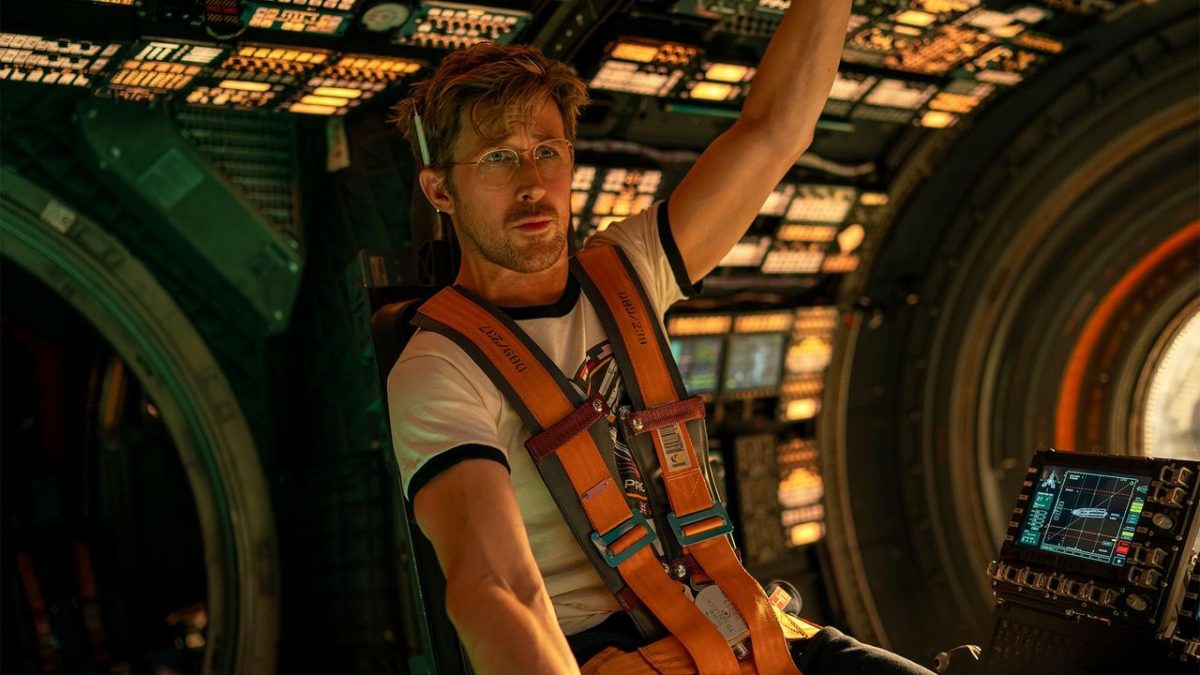





Imagine waking up amidst your greatest nightmare but having no idea who you are, where you are, or how you got there; that’s how “Project Hail Mary” begins, as the amnesiac protagonist Ryland Grace stumbles around a spacecraft hurtling through the galaxy. Grace works to piece together his identity and, along the way, discovers the universe-saving reason he is stuck on a spaceship. His loneliness, however, is only temporary, as Grace comes into contact with an alien named Rocky, who has a similar daunting purpose.
“It’s a story about saving the galaxy by making a friend,” filmmaker Phil Lord said on The Drew Barrymore Show in March 2026. Such a premise, Lord described, was the appeal of adapting Andy Weir’s original sci-fi novel “Project Hail Mary” into a Hollywood blockbuster starring actor Ryan Gosling.
Released on March 20, 2026, “Project Hail Mary” has received overwhelmingly positive reviews, amassing over $500 million worldwide and becoming the third-highest-grossing film of the year, according to Variety.
Lucy Wildeman (Class III) said, “I think it was one of the best adaptations of a book I’ve ever seen … They made it so accessible to people by taking out a bunch of the super science-y stuff [and] they told the story really well so that it was easy to follow.” Wildeman also appreciated the film’s focus on interpersonal and interspecific relationships. “They focused a lot on Grace and Rocky instead of some more science-y aspects, which, honestly, was one of the best decisions, because [their relationship is] genuinely why a ton of people love the book and love the movie,” she said.
Despite the emotional or experiential distance one might feel when observing Grace’s situation, Middle School Dean Efe Osifo said, “It’s one of those stories where I feel like you can wonder: What would I do in this position? How could I try to navigate this? Would I do the same things that the character did? It’s a cool way to put yourself in somebody else’s shoes.”
Within the sci-fi genre, Grace acts unconventionally for a leading character, which perhaps makes him more relatable to audiences. Deviating from the typically self-sacrificial protagonist, Grace — originally a scientist within an international operation dubbed “Hail Mary” for its low chance of success — refuses to be sent into space to complete the mission. “The fact that they made the main character an unwilling hero makes sense, because I sometimes get bored with the [same] hero complex of ‘Oh, I got to save everyone,’” Claire Chow (Class II) said. “I feel like humans are a little bit selfish because your mind is trained to save yourself. I think this was the first time that I learned about a protagonist who didn’t really want to save the world.”
Although initially hesitant, Grace’s eventual relationship with Rocky drives his altruistic actions toward their shared mission to save both their planets. “A special bond formed between [Grace] and Rocky, and I feel like it gives a little bit of hope. Humans [and other species] fight with each other all the time, but in the moment [where they first met], with languages that were completely different … they were still able to become really good friends, and [gradually] be willing to sacrifice themselves for the other,” Chow said.
The same type of unbreakable bond between space explorers captured the hearts of many worldwide during NASA’s Artemis II mission. From their takeoff on April 1, 2026, to their splashdown in the Pacific Ocean on April 10, 2026, the crew of Artemis II shared their groundbreaking experiences with the world through live news broadcasts. Answering interview questions from the comfort of their spacecraft, the crew acted as humanity’s real-time guides into a historic lunar fly-by operation — the first in over half a century.
Science Faculty Joe Liskowsky recalled, “I was with my sons watching, and we were glued to the screen when [Artemis II] was taking off. And it’s not a fast thing. It’s not a TikTok video. It’s not just like, ‘Oh, I get to see it,’ and seven seconds later, something else happens.” In stark contrast to the instant gratification of social media, space flights are equally, if not more, exciting sights that future generations will encounter frequently with current technology.
Kira Morales (Class II), who stayed up-to-date with the mission on social media, expressed her admiration for the crew and their ability to change her perspective on the world. “[One of their speeches] just made me think about how a lot of the problems on Earth, when looked at from above, are kind of small,” she said. The mission gave Morales something to eagerly anticipate on social media, while remaining informed on other worldly topics. She said, “I think it’s important to focus on exploration, because it helps people become more knowledgeable and gives … people [something they] can enjoy when they get the news. It’s news that is more fascinating, rather than fearful.”
Space exploration, at its core, whether portrayed through science fiction like “Project Hail Mary” or through real NASA missions, is the result of endless curiosity. “I think people being curious is just a good thing in general, and [it’s especially] cool to be curious about the land that you walk on and, obviously, the land that you don’t walk on,” Osifo said. The continued search into the depths of space allows humanity to further understand its role in the universe, a task that, at times, may seem ambitious. Despite its unknowns, support for space exploration has still emerged globally because of its ability to inspire remarkable hope for the future.