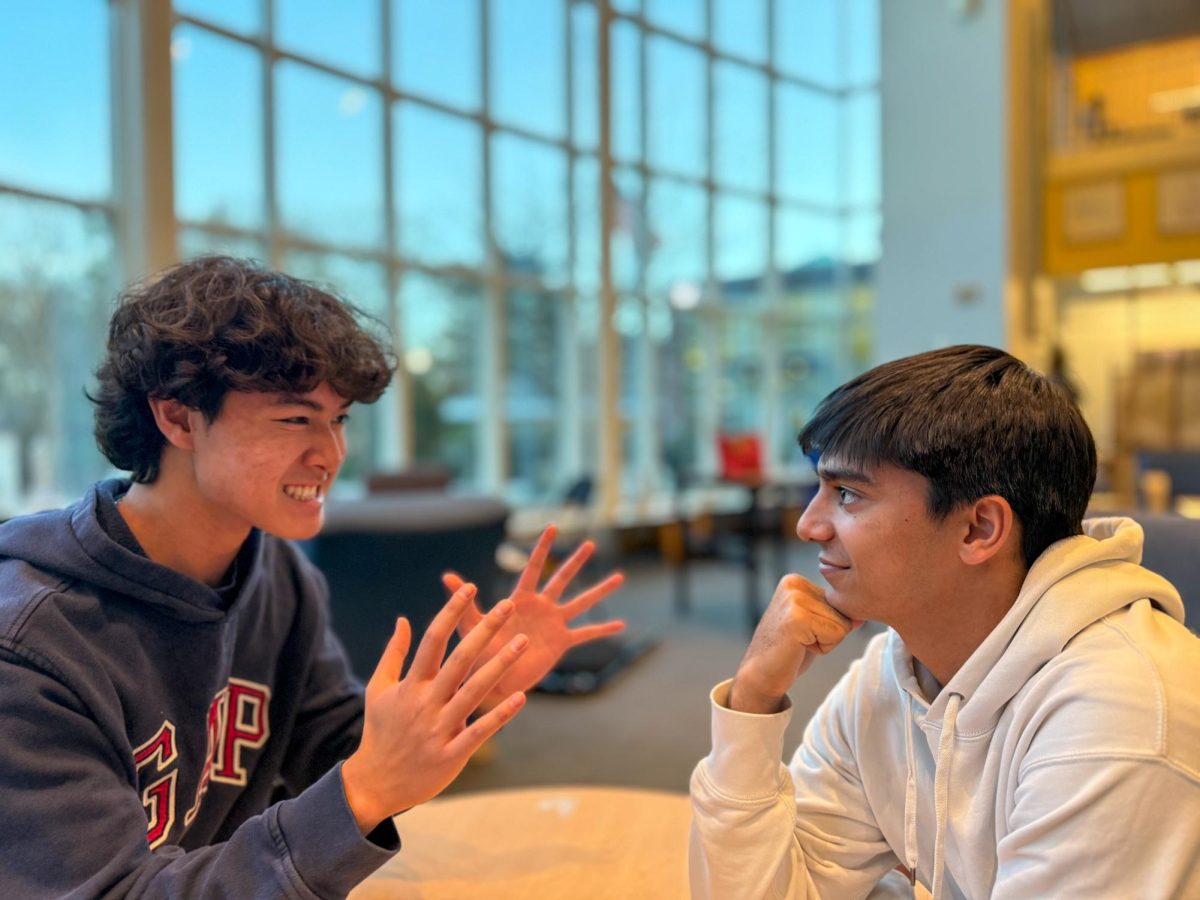



















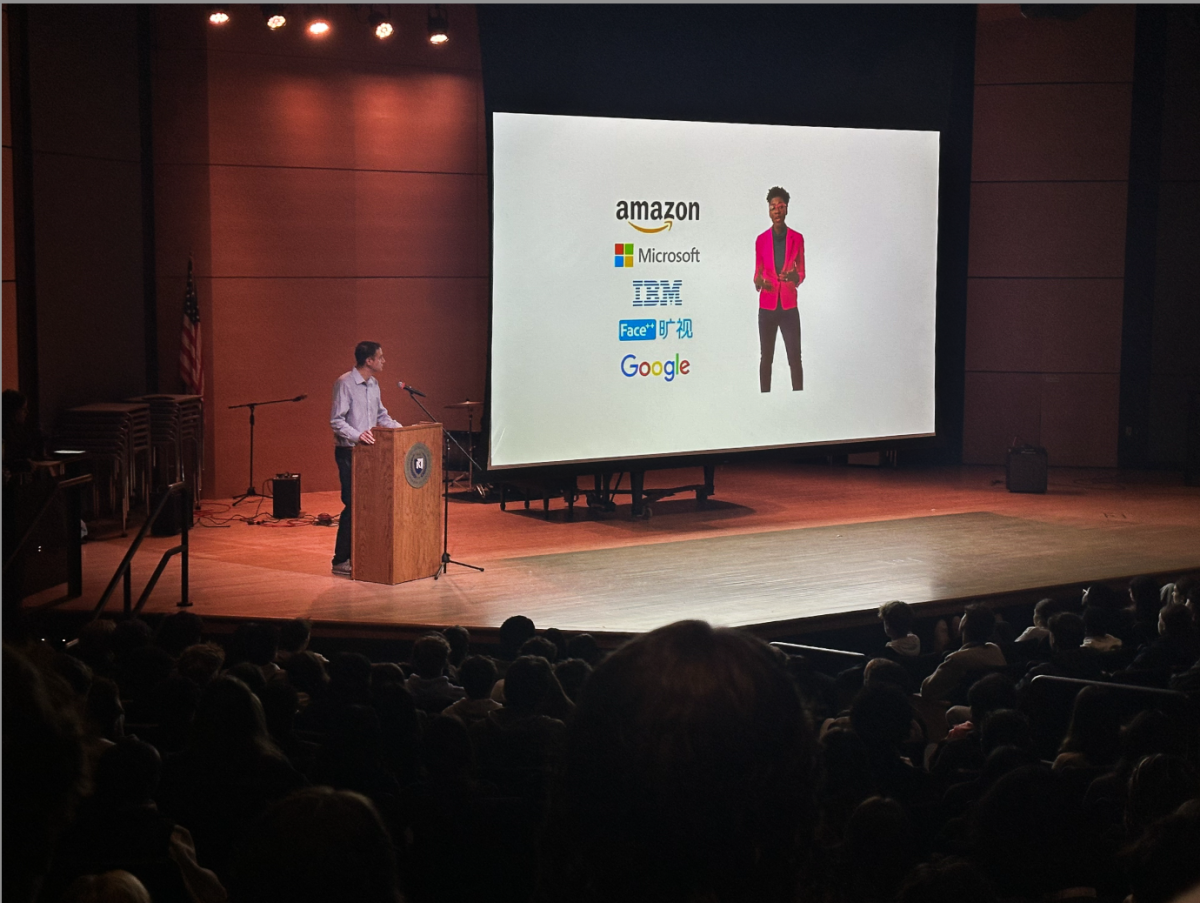
On October 17, Director of Teaching and Learning Mike Kalin and Computer Science Department Chair Max Montgomery presented the first installment of AI5, an assembly series providing information on artificial intelligence (AI). In conjunction with this series, the two initiated a student focus group on the same topic.
The group aims to incorporate student voices in discussions around AI’s role in student life. “It’s students that are most affected by the way that AI is changing education and your lives,” Montgomery said. “It’s really important for them to be involved in that process as they’re the product and the result of any decisions that we make.”
Furthermore, the focus group aims to create a general understanding of how AI sites, such as ChatGPT, are incorporated into education. “I’m not 100% sure among the student body what the specific use cases are. I have some instincts about it, but that was the reason for the AI focus group and committee: to try and get some student voices to help us understand,” Kalin said. Ultimately, this group was formed to ensure that the broader school community is prepared for the inevitable growth of AI and to facilitate conversation between students and faculty around this topic.
So far, discussions have centered on the various ways students use AI for studying, its pros and cons, and the issue of academic dishonesty, among other topics. “One of the major positives of AI is that you can use it to generate study materials, and it can help your learning. But a fear that a lot of us have is that AI can replace our actual thinking and decrease our critical thinking,” focus group member Yang Lu (Class III) said.
Furthermore, students in the AI focus group analyze and express opinions regarding the English Department’s red, yellow, green policy (red = full ban, yellow = AI for revising/proofreading, Green = AI at every step). Students have mixed reactions about this policy. Focus group member Clayton Dolinski (Class II) said, “We appreciate the fact that teachers have used red, green, and yellow assignments with details about how much AI you can use. With that being said, many students have noticed that teachers set those parameters at the beginning of the year and then assign AI Red tasks. It would be helpful to build off of those parameters and actually use all of them to their full extent.”
Others are more supportive of the current policy. “The fact that Nobles’ policy is flexible, so that each teacher can decide how AI works in their classroom, is really effective. And I think that is how society will work going forward. You have to get used to the fact that you’re going to be going to different spaces, and people there are going to have vastly different opinions on AI,” Harper Tyng (Class I) said. As mentioned earlier, AI is becoming increasingly ubiquitous in our lives, so the conversation will soon shift not only to academics but to life in general.
The focus group also acknowledges occasional student disregard for Nobles’ AI policy. Focus group member Lia Gavin (Class I) said, “Many of the questions concerned whether people are ignoring or breaking rules. And we definitely talked about how that happens a lot, so we’re trying to figure out ways that we can make it so that students are doing the work but also acknowledging that there are holes in that.”
Overall, the student focus group serves as a medium through which AI’s role at Nobles can be better understood. As such, conversation doesn’t only center around current policy, but also the future. “It’s clear that AI is not stopping, and especially with AI agents, which can do a lot of the tasks on your browser for you without any manual work. As students move on to college and their lives ahead, AI will be ever-present. Learning to adapt and live in a world mostly ruled by AI is going to be important for Nobles,” Lu said. Of course, given the rapid pace of AI development, our adaptation to it may need to happen sooner rather than later.
However, dialogue also exists outside of the focus group, specifically surrounding AI’s future at Nobles. Mathematics and Computer Science Faculty Molly McGuigan said, “I think that teachers will get better at using the technology. However, as AI continues to grow, and students have it embedded into everything they do, policies will have to become even stricter and clearer. We might have to go fully ‘internet off’ on some assignments.”
As the landscape of AI evolves, we’re fortunate to have access to a wealth of commentary and information about it. With the student focus group as well as AI5, Nobles is well prepared to continue adapting and improving its policies.