
















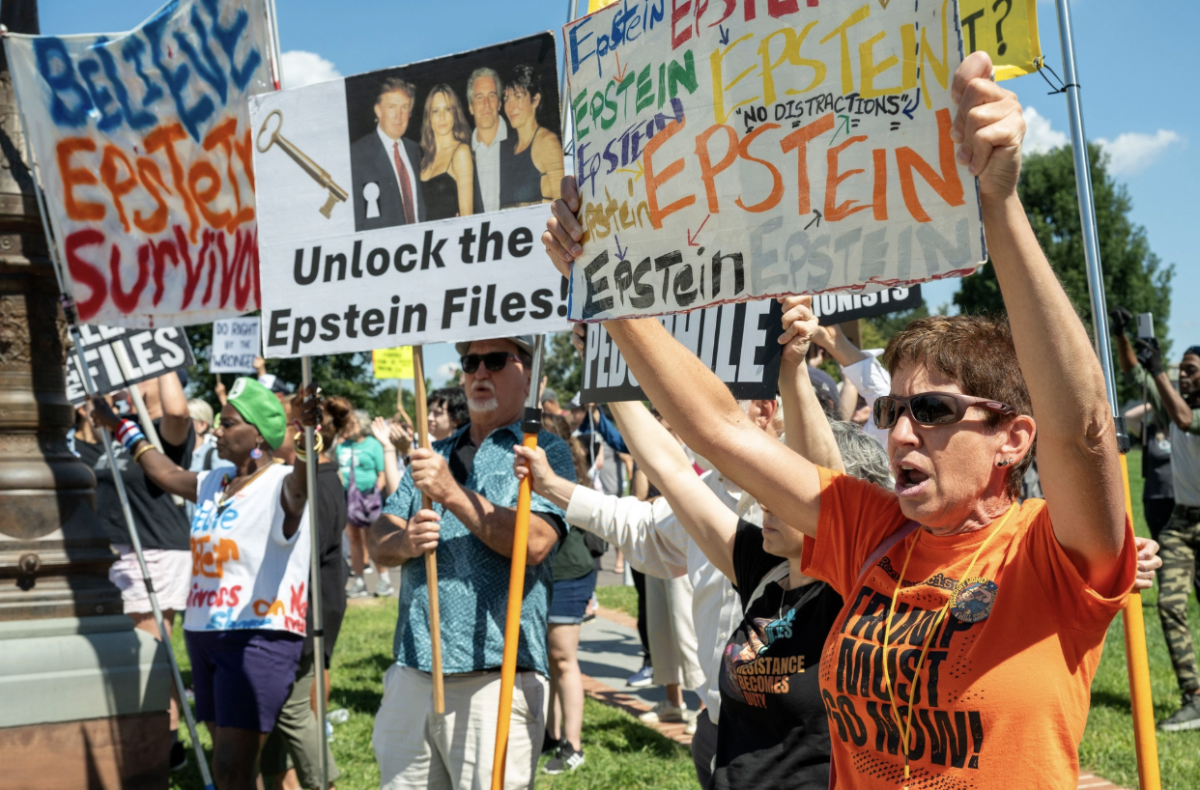
“America has had a problem historically with holding people accountable,” Chloe Coleman (Class II) said. As documents related to convicted sex trafficker Jeffrey Epstein have led to a rapid legal response abroad, the United States government’s inaction has sparked discussions about accountability and its response to these files.
According to the Department of Justice (DOJ), more than 3.5 million documents related to Jeffrey Epstein have been released thus far. Europe has quickly moved to take action against those implicated, including arresting former Prince Andrew and stripping him of his titles, arresting Peter Mandelson, a former UK Cabinet minister and British ambassador to the U.S., and criminally charging Thorbjørn Jagland, Norway’s former Prime Minister. However, in the U.S., the DOJ has declared its review “over,” making no further charges or arrests against any U.S. citizens implicated in the files. President Donald J. Trump is implicated, and he, along with many others at high levels of the U.S. government and national celebrities, has not faced any repercussions or further investigation.
Many students agree that rigorous investigations are critical. “Because we’re at a time where there’s not a lot of trust in the government, a very thorough investigation is absolutely necessary,” Devin Reid (Class III) said. Nahman Mack (Class II) further elaborated on the necessity of examining those implicated in the files. “All those implicated should be prosecuted, regardless of what the effect on the government would be if they were taken out. If they’re kept in and are guilty, then that’s a terrible precedent and keeps them in a position that gives them more power to do this in the future,” he said. Various perspectives prioritize different factors, considering both political and social reasons for the necessity of investigations.
Students also discussed why the U.S. government has not thoroughly examined implicated officials. “I think that a lot of government officials aren’t being prosecuted because many of the people who can control the investigation are in the files,” Reid said. Evie Shih (Class II) similarly believes that a conflict of interest is influencing the case. She said, “The way that President Trump is handling the situation with the Epstein files, a lot of the people in the DOJ and those he has appointed to handle these legal issues are loyal to him. There’s so much impact and so much power held by one person.” Shih’s concern reflects a broader worry about the executive branch’s influence over agencies like the DOJ and the optimal limit of that influence.
Students also dissected the disparity between the U.S.’s prosecution of those implicated and prosecutions in other countries. Mairin Swords (Class II) said, “Our policies should be more in agreement with the policies of other democratic countries similar to us. You’d expect there’d be some sort of judicial alignment.” The contrast between Europe’s swift action and America’s complete inaction has sparked debate over whether the U.S. justice system is capable of accountability and what changes might prevent future instances of inaction. “International cooperation is at the crux of this issue. An international baseline allowing for people to be held accountable, no matter what political or social aspect[s are involved], would be helpful,” Coleman said.
Students also considered a new piece of proposed federal legislation introduced in February, called “Virginia’s Law,” designed to eliminate the statute of limitations for civil lawsuits regarding sex trafficking and abuse. If enacted, this law would allow victims of Epstein and others to sue regardless of when the abuse occurred.
While students weighed both the benefits and drawbacks of the law and all presented criticisms, it seems they tend to lean overall in support of its passing. Shih said, “There are valid arguments on both sides. A lot of people wait to report abuse out of shame, embarrassment, or fear, but I also think that details can fade, which might make older cases harder to determine.” Reid further elaborated on the rationale in support of the law. “Especially with Epstein, there was a ton of intimidation. It’s very hard to come forward against people who are huge public figures, because people are going to doubt you and say you’re just trying to slander this famous person to get some money,” he said. Ultimately, Shih said, “It’s important that if someone has the courage to speak up about what happened to them, they take it seriously and consider it, and don’t just veto it.” Evan Wei (Class II) echoed this sentiment. He said, “There does need to be accountability, because if someone actually did something wrong, they do need to be held accountable, regardless of how much time has passed.”
While students considered the drawbacks of aged evidence and flawed memory, the consequences of ignoring victims were too severe. “The length of time that has passed should be taken into account while they’re prosecuting, but that doesn’t mean that these cases should not be prosecuted. I believe in a fair trial for everyone,” Mack said.
Current events like these, in which students largely share similar convictions, are rare in a climate of severe political polarization. If the government’s actions displease a strong portion of Nobles students, or even high schoolers or Americans alike, this situation provides a critical moment for people to capitalize on shared outrage to enact real change.