





















In the Uber Eats advertisement entitled “Bradley’s Mission,” actor Bradley Cooper attempts to convince a room of NFL executives to publicly address an issue that has shrouded the image of Cooper’s beloved Philadelphia Eagles. “Deny the conspiracy,” Cooper urges the executives, who seem to support the narrative that “football is only here to sell food” with their unwavering support of Uber Eats in sports events. Concerned that his cherished birds have lost their glamour amid accusations that challenge the very existence of their profession, Cooper calls for a public NFL denial of the hearsay. Cooper thus raises the surprisingly relevant question of how much food influences what people care about.
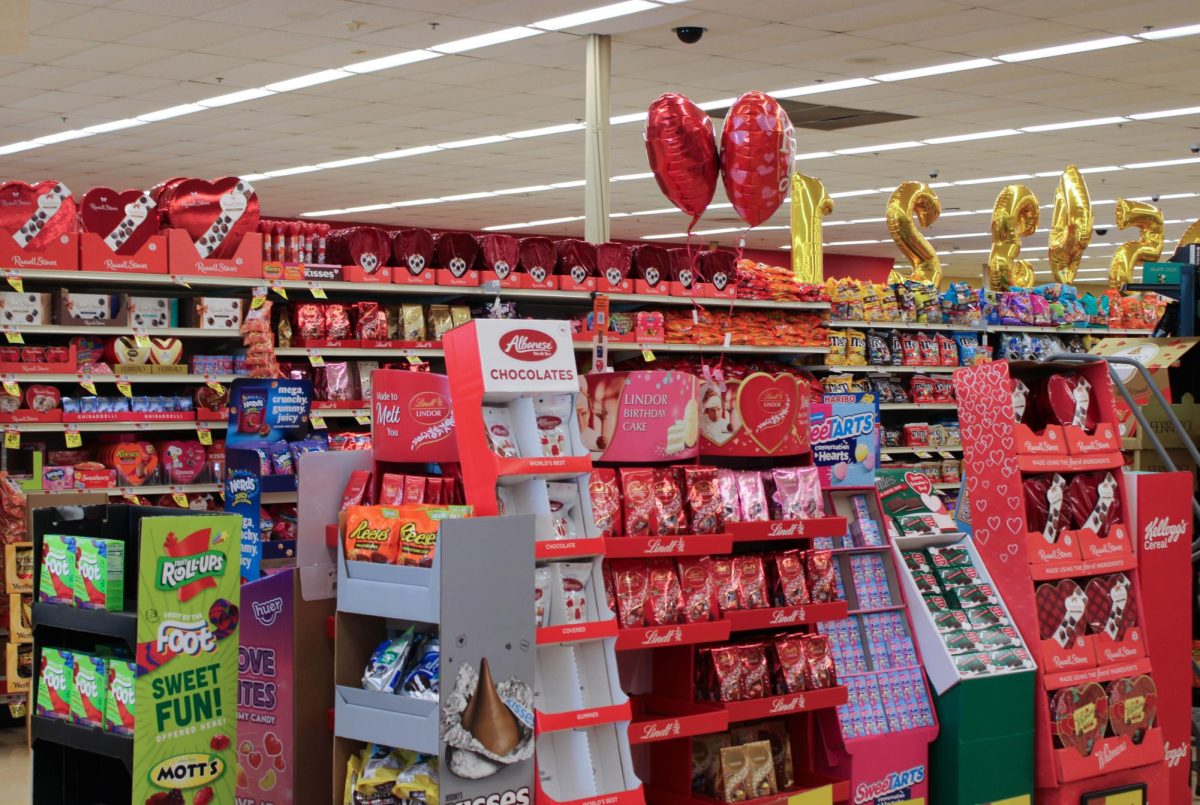
That question is particularly applicable on Valentine’s Day – probably the most food-driven holiday of the year. According to Capital One Spending, which also accounts for all the data cited in this article, the average American budgets $188.81 for Valentine’s Day, with candy taking up approximately 56% of that total. Spending nearly $100 on candy — which usually ends up being some sort of chocolate — for a single holiday may be outrageous, but constant corporate advertising helps explain it. Stores begin placing Valentine’s Day products on their shelves as early as January 2, urging consumers to start shopping before the New Year’s confetti has even settled and their bank accounts have recovered from the holidays. If you buy into this persistent stream of marketing, it’s easy to believe that, for example, purchasing a box of chocolates for your crush every day until the fateful February 14 would not be excessive but strategic.
That strategy of overconsumption has proven effective. Take it from Christian Weller (Class II), who, in 2024, bought 50 roses from the CAC sale for a single person. That tendency to overspend then escalated the following year. In 2025, Weller purchased a new box of chocolates from his local CVS every day leading up to Valentine’s Day for his love.
“I was simply caught up in the moment and my person,” Weller said. “I walked into that CVS right after New Year’s, while they were setting up the Valentine’s displays. There was just something about the pink packaging and limited-edition chocolates. I just couldn’t resist buying them. I didn’t expect to get pulled into this tornado of chocolate spending.”
However, chocolate has not always dominated Valentine’s Day. In 2015, chocolate officially overtook greeting cards as the most popular gift, with 53% of consumers purchasing chocolate and 51% purchasing greeting cards. This was not a landslide victory for chocolate; rather, it was an infiltration of Valentine’s business, with consumers purchasing more chocolate than any other gift a decade later. In 2025 alone, Americans spent an estimated $2.5 billion on Valentine’s Day candy, approximately 58 million pounds of chocolate during the week of the holiday.
The scale of this consumption suggests a coordinated effort or, at the very least, an extremely successful one. If Valentine’s Day were truly about love, it is unclear why its most essential requirement has become cocoa.
Despite the financial commitment, the results of gift-giving remain mixed. Americans spend up to $9.5 billion each year on Valentine’s Day gifts that are ultimately unwanted by their recipients. This raises serious questions about efficiency, intent, and whether love can, in fact, be measured in ounces.
Perhaps the most concerning is the rise of self-gifting. In 2025, 47% of Valentine’s Day shoppers — nearly 150 million Americans — planned to buy a box of chocolates for themselves. What began as a celebration of romance has evolved into a closed-loop consumer system, in which individuals both create and satisfy their own demand.
Carson Case (Class IV), a self-described chocolate enthusiast, purchased her own Valentine’s Day gift last year. “I wanted to reward myself,” she said. “I saw some of my friends getting gifts from their significant others and wanted to join in the fun.”
With Valentine’s Day spending projected to reach a staggering $29 billion this year, consumers are faced with a choice. They can continue contributing to a system that converts affection into candy sales, or they can redirect their money toward something with longer-lasting value — savings, tuition, or literally anything that does not melt. Love may be priceless, but chocolate, according to the data, certainly is not.
So if you find yourself standing in the checkout line of shame at some point tomorrow — whether by societal or store pressure, or even by your own choice — try to take another minute to look around the store. Consider putting back the chocolates. Sometimes the bravest act of love is walking out empty-handed, and the most meaningful Valentine’s Day gift is the one you don’t buy. True love doesn’t melt.