





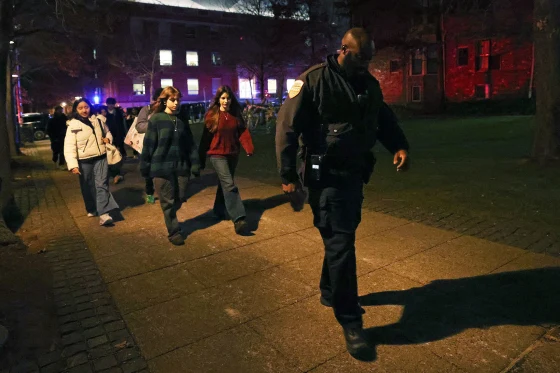
As Brown University student Eli Schotland (N ’25) worked through his physics final exam on December 13, 2025, in a classroom with 250 other students, he heard a harrowing announcement. “The Teacher’s Assistant got up in front of the room and said, ‘Hey guys, sorry to bother you, but we just received news that there’s an active shooter on campus,’” Schotland said. From there, the day devolved into a series of hours-long shelter-in-place lockdowns. “There’s this abject kind of fear that you get. They basically told us that they didn’t know where the shooter was, but that he was very close by and could be coming here. So you do get seized by a feeling that you’re about to die,” he said. 10 Campus Drive, a mere 45 minutes from the nightmare Schotland faced in Providence, has grappled with this shooting by reevaluating its own safety and the ways that the government should respond to the public safety crisis caused by mass shootings.
The proximity of the shooting and the relationships students have with the university made this tragedy feel all too personal. Erin Campbell (Class I) said, “I actually spent some time on Brown’s campus a couple of summers ago … I know people who were on that campus … You hear about shootings all the time, unfortunately, but having it so close by in a place that I’ve been, just feels like ‘wrong place, wrong time.’” This sense that a tragedy could strike anywhere, even in nearby and familiar institutions, has forced students to reconsider their own sense of safety.
Despite the close vicinity of the Brown shooting, though, most feel safe at Nobles and in their day-to-day lives. “For my own safety, I’m not that nervous. It’s very unlikely that I myself will be harmed … Even if I go to a place where something like this happens, it’s still very unlikely,” Alex Cai (Class II) said. Campbell shared this sense of security. She said, “There’s definitely a feeling of safety here, and you just feel like that could never happen here.” However, she noted a hesitancy she feels with this sense of safety. “I’m probably less nervous than maybe I should be,” she said. While some students feel safe, others worry about what the future may hold. “[As we matriculate into various colleges], one of us is probably going to be at a school where there’s a shooting,” Alessia Shelley (Class II) said. This tension between present safety and future vulnerability has guided Nobles’ preparation for potential emergencies.
The school’s preparation for shootings involves intensive faculty training with minimal student drills or education. History and Social Science Faculty Beth Reilly explained the rationale behind this method. “The current thinking from experts is that the preparedness you might be able to provide to kids is outweighed by the anxiety and the terror that might come with it,” she said. Reilly emphasized that the school seeks to balance safety with our community values. “If we lived in a padded cell … we would improve our odds of avoiding a horrific shooting. But there’s an awful lot that would also be lost … we still have to live a life with some openness and connection and community,” she said. Schotland proposed an additional preventative measure: mental preparation to prevent panicking. “I think everyone should run through in their head what they would do in a life or death situation … having a plan for that sort of thing is really helpful, because if you have a task to focus on, you’re not going to panic,” he said.
Members of the community are in agreement that preventing future tragedies of gun violence requires the consideration of multiple factors. “To treat the mental health crisis which is at the root of this issue, it would help to have safe spaces for open discussions about mental health to reduce feelings of isolation … to prevent individuals from feeling alone or violent,” Cai said. Reilly raised another critical consideration, discussing gun regulation as a necessary preventative measure. “[I would advocate for] much more rigid gun regulation. Guns in the hands of people without mental health issues may never be used in mass shootings, and disturbed people with access to nothing more than a knife would also help limit mass killings,” Reilly said, “Right now, people with anger issues, mental health issues, and addiction issues may also have access to extremely dangerous weapons that can inflict massive damage and death in seconds.”
Despite standing witness to one of the nation’s most recent and prominent school shootings, Schotland returned to the Brown University campus the next day to ensure the safety of his friends. “I think it’d be a real shame if anyone were to let fear of something like this prevent them from doing something … I don’t think fear and preparation for a kind of doomsday situation should dominate anyone’s day,” he said. His return to campus embodies the balance the Nobles community seeks: acknowledging the threat of gun violence while refusing to surrender the values and connections that make our community so special.