








Director of Instrumental Music Antonio Berdugo came to the United States in 2004 with fluency in the language of music, but not in English. Continuing his violin studies — which began in his hometown of Santa Marta, Colombia — at La Sierra University in Riverside, California, Berdugo added a semester of English as a Second Language to his coursework. “My main challenge at that time was the language. I wanted to talk to people, but I didn’t have the words. [I tried] connecting with people without words. I was able to [do so by] playing violin with [them],” Berdugo said.
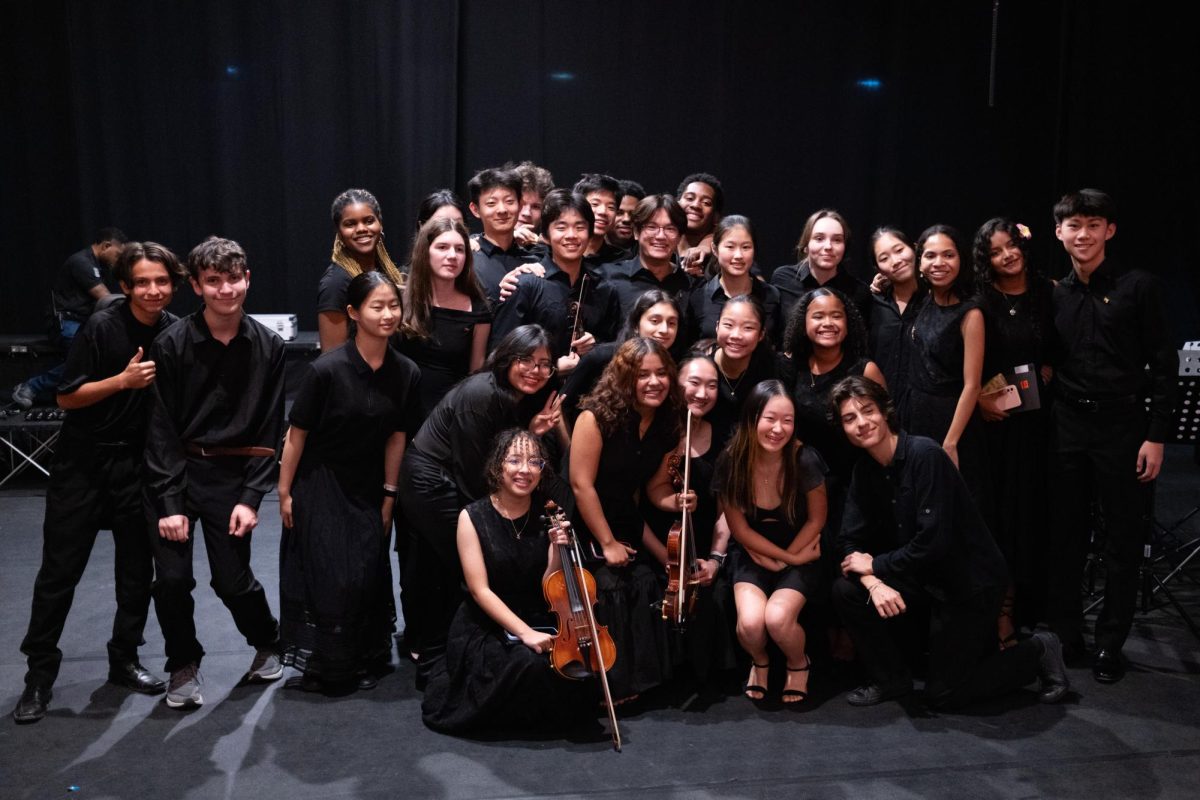
Connecting with other people through the universal language of music was one of the primary goals of the 2026 EXCEL spring break trip to Colombia. Spending time in Santa Marta, a group of 20 Nobles students — each of whom plays an instrument in at least one of the school’s musical ensembles — and five faculty chaperones collaborated and performed with youth musicians. Working with a school choir and both beginner and seasoned instrumental musicians within an organization called Cajamag, Nobles students experienced the same unique musical connection, despite a verbal language barrier, that Berdugo described upon his arrival in the United States.
Before the trip, Berdugo expressed his excitement about the potential for music to bridge gaps between the lives of Nobles and Colombian musicians. “I gave Nobles students this code on paper that we call sheet music. [They] have to learn that in [their] instruments, and then the Colombian students are doing the same over there,” he said. “The power of music is [apparent] when, regardless of country, culture, language, these two groups are going to start playing the same thing … in the [sheet music], and it just matches, fills together, grooves, and blends.”
Knowing that trips like the one to Colombia are often life-changing, Admission Coordinator Erika Charles was eager to chaperone and reconnect with her love of music as a former oboe player. “One of the reasons I enjoy music as a listener and performer is that it can transport us to new places. It’s hard not to feel moved as you sit in the middle of an orchestra and hear all the instruments around you coming together,” she said.
Naturally, Berdugo’s musical choices for the trip paid homage to the country’s roots, giving Nobles students the opportunity to play traditional pieces while in Colombia. Most of the pieces originated in the north of the country, where the Nobles contingent stayed, and showed similarities to the music of other Caribbean nations, such as Cuba and the Dominican Republic.
From Joe Arroyo’s “La Noche” and Lucho Bermúdez’s “Colombia Tierra Querida,” both staple compositions familiar to the Colombian audience, to “Indio Tayrona,” a piece named for an indigenous group living in the mountains of Santa Marta, the repertoire greatly expanded students’ musical knowledge and instantly united the orchestra with its audience.
Similarly, Indira Nalwaya (Class II) shared how much joy music could bring to all involved, recalling audience reactions to the orchestra’s performances at Colegio Bilingüe Santa Marta (CBSM) and a local senior center. “At CBSM, I saw one young girl sitting in the front row who started off frowning and bored, but began smiling and singing along during ‘Indio Tayrona.’ At the senior center, I saw blank stares at the beginning, but smiles and laughs a couple of songs in,” she said. “The drastic change in these people is what hit me the most. Even if they were having a bad day, our music gave them some light — even if it was just for a short time.”
Throughout their time in Colombia, trip leaders emphasized the importance of service through music, hoping that students would see the journey not simply as what they were doing for the Colombian musicians or as a way to gain community service hours. Rather, they hoped that students would be able to reflect on what the people in Colombia could help them learn in return.
For example, before the trip, Nalwaya expressed concerns about language barriers, but after, she realized that music and the people she met played a significant role in overcoming those obstacles. “I was talking to the Cajamag drum teacher, Jhon. I was telling him about my interest in drums, and he wanted to teach me some salsa rhythms, but he barely spoke English, and I barely speak Spanish, so you can imagine it was difficult,” she said. “Finally, he just pulled out his iPad and drew the rhythms out in musical notation, a language we could both understand. I even took a picture of it to practice at home.”
Berdugo returns to Colombia as often as he can and learns something new each time. “When you have the opportunity to be exposed to other thoughts, opinions, ways of speaking, mannerisms, traditions, [and] cultures, it opens up way more possibilities,” he said. Eager to share his culture with students, Berdugo noted that he, too, could continue to learn from a place he called home. “As a Colombian musician, [the trip] gives me a fresh approach to Colombian music and how I interpret [it],” he said. The trip did not fail in its promise to give members of Nobles a life-changing experience, one built on music and connection to create harmony beyond words.