








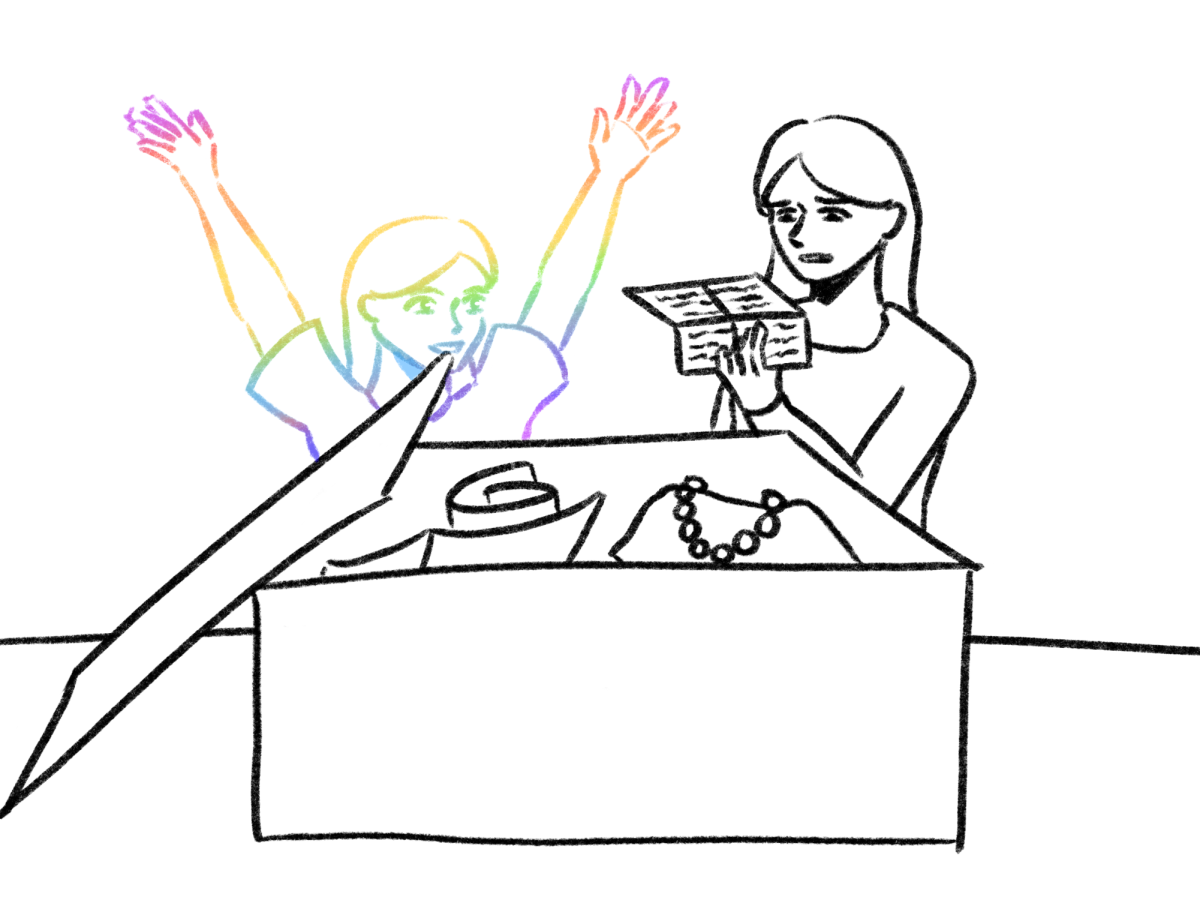



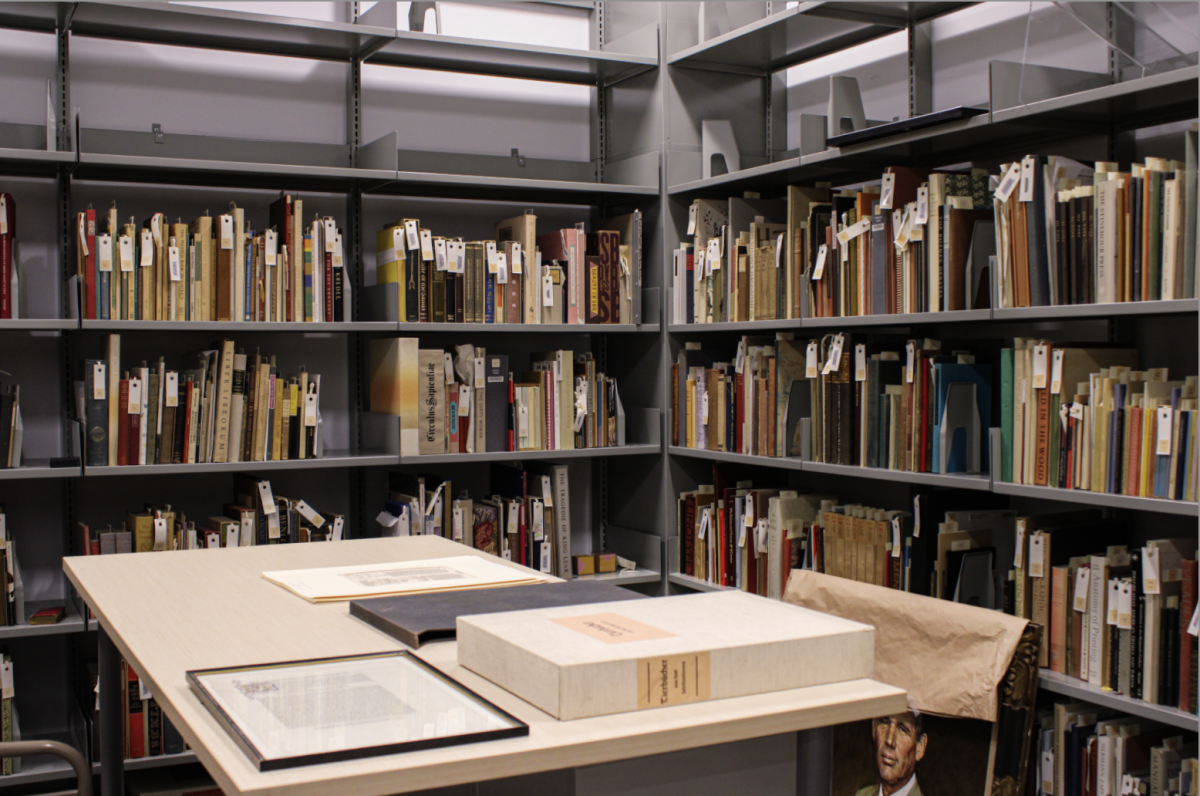
One of the hidden gems of Nobles is the rare books collection, a carefully preserved archive that allows students to interact directly with centuries of history, art, and knowledge. The collection began in the late 1990s through a major donation from a couple, Walter and June Tower. Walter Tower worked in the printing industry, and together the Towers collected rare books as a lifelong hobby. As they got older, the Towers downsized their personal library and donated 1,300 books to Nobles as parents and grandparents of students who had attended. Throughout the next 20 years, the couple continued to expand the collection, occasionally sending a new box of books to be added to our archives. Librarian Emily Tragert oversees the collection.
When designing the rare books room, Nobles worked closely with the Northeast Document Conservation Center (NEDCC), an organization specializing in the preservation of historical materials, to design a room optimized for the collection. The collection is housed through a small door in the Glass Room in the Edgerly Academic Center. There are climate-control systems, steel shelves, and a fire-suppression system to help protect the books. The distinctions between books kept in the rare collection and those available for everyday use often depend on a book’s age, fragility, and the number of existing copies in circulation. “For a library like ours, part of it is the fact that we want them to be kept away in a special collection, so they’re not just able to be checked out by anyone,” Tragert said.
Among Tragert’s favorite items in the rare books room is a collection of songs compiled by Claire Van Vliet. She founded the Janus Press, which is a printing press renowned for producing poetry made with original illustrations and handmade paper. “Mr. Tower had dyslexia, and he told me once that because of that, he really loved and resonated with images, so he tried to collect a lot of books that had really beautiful images in them,” Tragert said. Each page contains an excerpt of a song written by St. Hildegard of Bingen, a 13th-century German abbess whose religious compositions are still sung today. Along with each excerpt is a handmade, exuberant pop-up that jumps off the page. Tragert said, “I think it’s really an amazing example of the work of the Janus press, because it makes you feel the way the songs make you feel.”
One of the collection’s most striking artifacts is a page from the Gutenberg Bible’s Book of Numbers, printed in the 1450s. Only around 48 copies still exist today. The page was originally part of a Bible that had fallen into poor condition and was dismantled for sale as individual leaves. “The way they printed and sold books at this time was you went to the print shop, and they sold you a stack of paper, and then you took it home. Then, you had it bound and decorated. So all the rubrications are done by hand,” Tragert said. The page, printed on thick, cloth-based paper, is still vibrant and beautiful 500 years later, with red ink decorating many of the letters.
The rare books collection contains informative primary sources that are examined in multiple history and Latin classes. History and Social Science Faculty Nahyon Lee has brought her classes to examine primary sources from the collection for nearly a decade. “I first tried this approach in History of Human Communities (HHC) during our Christianity unit, when Ms. Tragert brought in several Bibles — some written in Latin, traditionally used by the Catholic Church, and others translated into vernacular languages like German as part of Protestantism after the Reformation,” Lee said. She has a vision for how her classes interact with these sources in a way that goes beyond just looking at them. “My hope is that by seeing Bibles in native languages, students understand how rare literacy was and why translation mattered. Being able to read was a privilege, and colonists and missionaries often learned native languages in order to translate the Bible and use it as a tool for conversion,” she said.
Across multiple history and arts courses, the rare books collection has proven to be a highlight of students’ classroom experience. Raul Cruz (Class II), who took Advanced Topics in European History 1500–1800, said, “It was nice to know that Nobles values learning about the history of the books before using them.” Adam Malima (Class II), a member of Lee’s Global History II class, said, “It’s interesting to see how carefully they protect and copy the information to not let it be damaged over time, especially for how long they have had it.” For Lee, the value of the collection lies in the interactive experience. She said, “As a history teacher, it’s really meaningful for me to be able to show students actual pieces of history. I can show images or videos on slides in class, but going to the Rare Collections room and seeing a real artifact feels different.”
Ultimately, Tragert hopes the collection encourages students to reflect on the value of physical books in a digital age. She said, “There is an excitement and a joy in holding the object and imagining someone who was using that object 500 years ago. Asking yourself questions about that can lead you to other conclusions about the time or the way people used books, or the way people interacted with the knowledge in the book.”