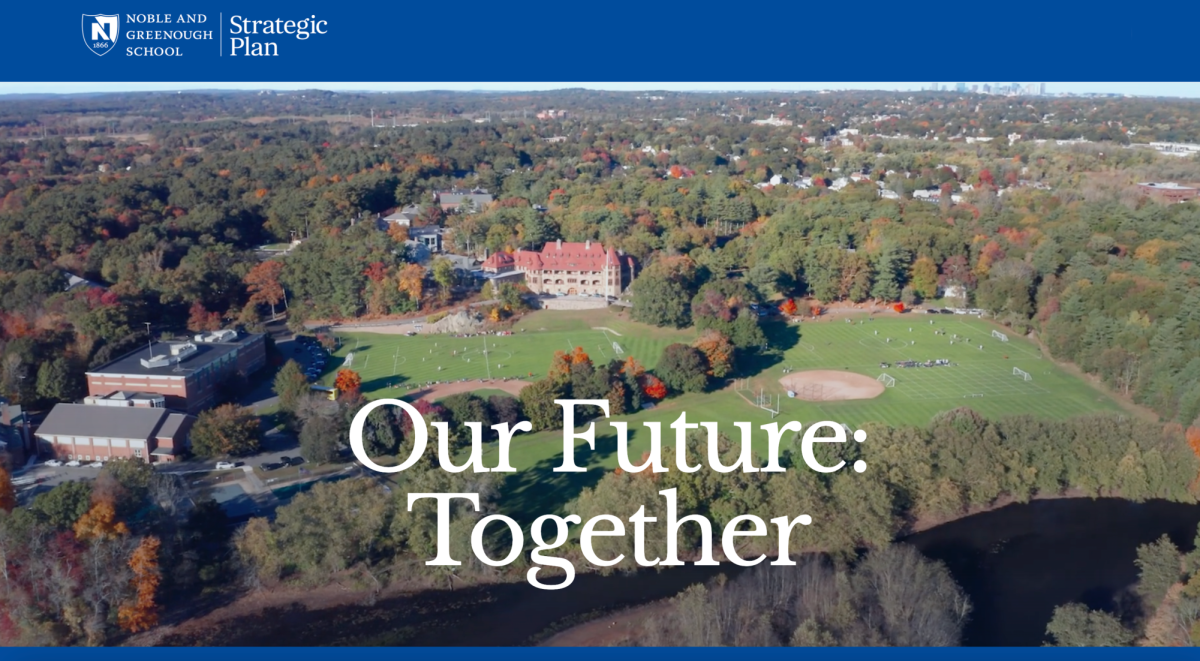











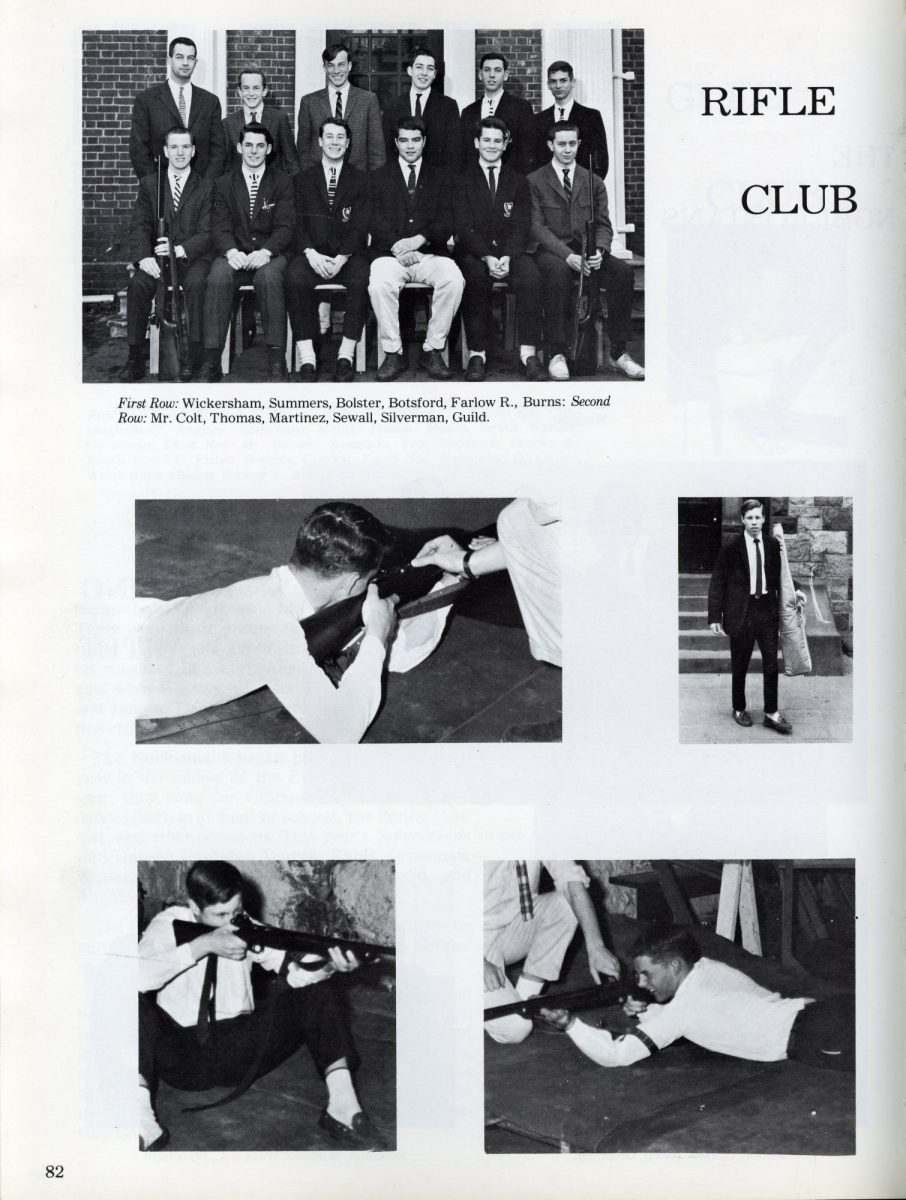
Imagine standing on Castle Field, watching the sunlight bouncing off the Charles River. Though instead of facing the home plate on the baseball field, you see targets. Small black targets, the size of an 8.5 x 11-inch piece of paper — ones used for rifles that are shot through the small gaps in the wall of the Castle’s basement. While it seems impossible now, this was a reality for Nobles students for decades.
These bygone rifles last appeared at Nobles Day Camp, where students shot .22 Long Rifles with iron sights from the Castle’s shooting range. “There was a hierarchy of shooting activities that you could get better at,” Nobles Day Camp shooter alum, John Gifford (N ’86), said. This hierarchy began with BB guns, fired outside near the Old Gym and Woodshop, where Richardson Gym now stands. Once graduated from the BBs, one would begin rising the ranks of shooting .22s: on one’s stomach, sitting up, and finally, reserved for only the best of the best, standing. Since the school had no more shooting classes at that time, the shooting activity at Day Camp was a special event. Jay Mofenson, a Nobles Day Camp student from 1979, said, “We would take shell casings from the .22’s home as souvenirs.”
Rifle classes date back to World War I, when the interim Head of School of Nobles, George F. Fiske, called for the initiation of a School Battalion under the student captain, Richard A. Cutter. Cutter wrote about this Battalion in a handwritten draft from October 16, 1918, addressed from 100 Beacon Street (the school’s prior location): “This Battalion will be equipped with rifles and (this following part he had crossed out) probably with bayonets. The instructors will be alumni of considerate military training and undergraduate non-commissioned officers, who have had previous training.”
The School Battalion was consequently initiated in response to an overwhelming feeling, on the part of the school’s leadership and students alike, that they needed to be helping the Great War effort. An editorial in The Nobleman wrote of the student’s duty in May 1917, “It is our duty to supplement [our countrymen] by a compulsory system of military training.” Similarly, the Commanding Officer of the Battalion, Francis P. Williams, wrote in February 1919, “The School, feeling that it was its patriotic duty, took up military training. Two companies of forty men each were formed; rifles and uniforms were procured. Drill was held two hours a day, twice a week, at Dexter’s Field.”
During World War II, the school invested even more of its resources in preparing its students for military combat, and rightfully so, as 23 out of 24 students in the Class of 1940 and nearly 400 alumni served in active duty before the war ended. The school began offering academic classes focused on military tactics and awarding academic credits for these new courses in the armed services. “War Courses,” such as “Pre-Flight Aeronautics” and “Navigation,” were offered in the course catalogs of the 1942–1943 and 1943–1944 school years.
Moreover, students at the time believed that the best way to prepare themselves for a future in the military, which seemed nearly guaranteed during World War II, was to maintain the best possible physical shape. “A concrete investment, in time of war, will always be physical training, best attained through compulsory athletics in all schools; its value can never be exaggerated … most arts of skill, bodily contact, and teamwork have tremendous value as training for rigorous militarism,” a writer for The Nobleman, John Hemenway (N ’42), wrote.
To expand their efforts to have each student in prime physical shape, the school mandated physical fitness tests, which were summarized by writer Denis Henry (N ’48) in The Nobleman in April 1944: “The tests were very much like … the tests given to Navy boys at college … Several of the younger boys showed need of a little extra work, which was consequently cheerfully given to them in a special class. All in all, the tests were very encouraging and, in giving each individual a chance to display his abilities separately, proved very beneficial.” Though both the physical training courses and the compulsory athletics ended immediately after the war, the school continued to offer some training geared toward military careers.
One last hurrah for military training at the school was a middle school afternoon program, run by English teacher Richard Baker, during the 1970s. The program, which focused on compass navigation, was based on the techniques Army soldiers learn at the Ranger School. The Ranger School, founded in 1950 and still in operation today, is a 62-day grueling course that teaches the highest level of military leadership and resilience under intense physical and mental pressure. Baker said, “What was most fun about [the program] was that I had the whole of the Nobles property to play with. And from my perspective, having Sixies and Fifthies trooping around the property with a compass was worthwhile.”
Although there are no remaining rifle courses or military training, we appear to be preparing students for military action in the same manner as past staff members of The Nobleman vouched for, through an emphasis on “most arts of skill … and teamwork” in our athletics programs, activities, clubs, and classes.