




















Students anxiously awaiting the start of the AP season must learn electron spectroscopy, diminished seventh chords, and the ablative case to prepare for some of the 42 tests offered by the College Board. A new 43rd test, AP English Analysis (of Texts), is the most highly anticipated new exam to be added to the AP curriculum. Geared toward over-analyzers, this test focuses on how well teenagers can interpret and obsess over text messages from peers, employers, and partners.
It’s essential we know how to analyze text messages. It is important to know whether your best friend is in love with you or angrier with you than they ever have been (because it is only ever those two extremes). The great thing about this exam is that everyone has been studying for it their entire lives. Riya Saha (Class II), a future scorer of 5 on this AP exam, said, “I feel like analyzing texts is just human nature at this point. You know when you get a notification, and you’re like, ‘Oh my God, what did this person say?’” The only necessary prerequisites for this test are having a phone, preferably being a teenager, and having a modicum of social anxiety. Beyond that, each high schooler has been working on this skill for as many days as they’ve had anyone to text. That’s why it is so helpful to centralize all of the knowledge they have accrued into this examination.
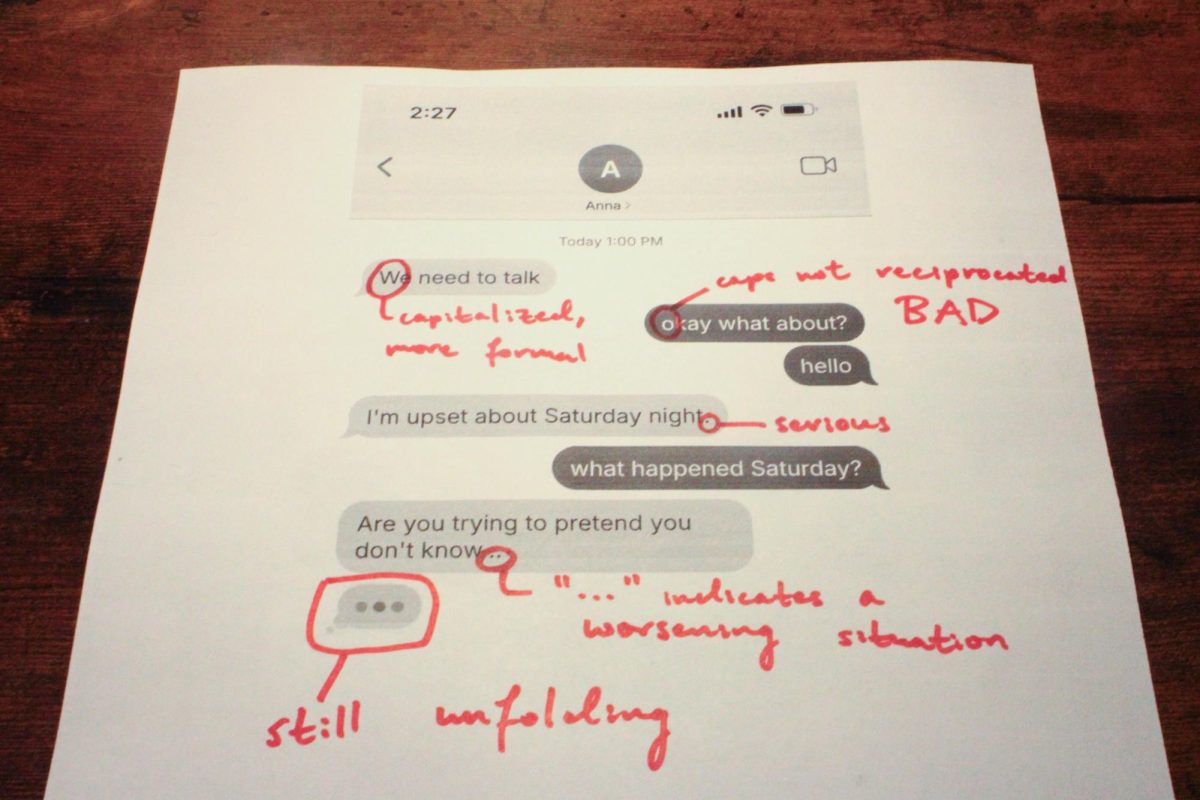
Here’s a sneak preview of what the College Board test writers — in conjunction with their trusty group of Gen-Z and Gen-A linguist advisors — are cooking up for the first run of the test: 30 multiple choice questions and 6–7 Free Response Questions (FRQs). For the multiple-choice section, picture your run-of-the-mill English text analysis. Only instead of analyzing the Orangedrink Lemondrink Man in The God of Small Things, you’re analyzing Anna’s text to Miles that made him apologize profusely for something he wasn’t aware he did last Saturday night. To get the question right, analyze word choice, capitalization, and punctuation. If Anna ends her text with a period, the answer should be A: Miles shouldn’t have just apologized; he should have written an essay over text to prove his love to her. If she says “I’m fine,” the answer is B: The bare minimum response would have been Miles driving to her house with a bouquet of flowers and begging her to reconsider. If her read receipts are on and Anna still hasn’t responded, that’s answer C: Miles has got to at least do some very public gesture to demonstrate his unfailing dedication to Anna. And if she says, “We need to talk”… well, Miles, we’re sorry, but the answer is D: We hope you find someone else nice.
For other multiple-choice questions, one can prepare to answer E: all of the above, since a single text can often be analyzed in myriad ways. If the sentence is “Wow, your outfit looks great,” and the reader isn’t given any context beyond that it is a guy writing to a girl (the test will give very vague context for each question), one could presume this to be a non-romantic friend, a boyfriend, a father, a sarcastic bully, or even a guy talking to a really great burrito he just ate and accidentally voice typing a girl. If the test-taker is enough of an overanalyzer, every meaning is possible. They just have to put their mind to it and defend their answer!
For the FRQs, students will be asked to justify their interpretation of a text’s meaning. To get some practice on this section, let’s look at an example. The sentence reads, “That’s ok!” Although this may appear to be “low-hanging fruit,” as Science Faculty Sheila McElwee would say, a couple of small details make this one tricky. First, the capitalization seems formal, so if this is coming from a friend, it’s pretty distant, meaning they might be mad. If it’s from an employer, however, this capitalization is perfectly normal and doesn’t denote any abnormal emotion. Second, the “ok” isn’t spelled out, and it isn’t capitalized either. If it’s an employer, chances are this means you’re in big trouble — no spelled out “okay” or capitalized “OK” from a Gen-X or Baby Boomer presumably means their head is just about on fire with what you did wrong. If it’s from your friend, on the other hand, you’re probably in the clear! Don’t worry, the exclamation point you just saw is there to encourage you to keep studying. We’re not mad. Third, the punctuation must be considered. In a normal sentence, the exclamation point just suggests, well, exclamation. But after a loaded sentence like this one, the exclamation point could have a darker undertone: A friend wanting to appear friendly while actually quietly fuming.
Hoping that students will find all these distinct meanings, the College Board instructors will then ask students, as in the English Literature and Language Composition exams, to craft a compelling, cohesive argument to convince their readers of why their overanalysis is most correct. And voila! FRQ 1 is complete. Only five or six more texts, which seriously make you think about how your friends feel about you, to analyze, and then you’ve got your hard-earned AP 5!
The exam is a great chance for students to be tested on a subject that they practice every day, and it will help homogenize texting etiquette for decades to come. And if you come out of the test sad that it’s over, don’t worry! The second you get home and start looking through your phone, you’ll have the chance to do it all over again.